




- Writer 총장실
- 조회수 4944
- Date 2017.11.27
How Yonsei University and APRU could Play a Role in the
Sustainability of the Pacific and its Societies
President Yong-Hak Kim, Yonsei University
November 8, 2017
I. YONSEI AS AN ENGAGED UNIVERSITY: THE BACKGROUND
II. YONSEI’S GOALS FOR SOCIAL DEVELOPMENT
III. YONSEI’S 2017 INITIATIVES
I. YONSEI AS AN ENGAGED UNIVERSITY: THE BACKGROUND
The world is changing; it is physically becoming closer. Whether we are overseas or at home, we are always connected. Global warming, transboundary air pollution, the Middle East Respiratory Syndrome (MERS) and WannaCry ransomware are classic examples of this changed, hyper-connected world. The global village is getting closer and more closely linked. Therefore, the issues of the global community becomes an issue for everyone, and this is only truer for the Pacific Rim region.
In September 2015, leaders from 193 countries of the UN gathered to adopt the Sustainable Development Goals (SDG) project, setting 17 goals and launching 15 years of business by 2030. The SDG project is a joint project undertaken by the global community. To promote this project, universities and higher education institutions are being asked to participate more actively, and many universities are making a transition to become “engaged universities.”
Universities have a special role to fill. Dr. Jeffrey Sachs, the Director of The Earth Institute at Columbia University, said, “Universities are, uniquely, repositories of knowledge, and most important, they are repositories of unbiased knowledge.” Consulting firms, companies and international organizations must be able to reorganize their development work in the form of transferable knowledge, but they have conflicting agendas and tend to lack academic and systematic reflection; thus inevitably the same mistakes are repeated in the field. Therefore, universities must be involved throughout the various stages in sustainable development work for the global community. The world’s leading universities are making active changes in university structure and programs. Universities are making decisions to change in response to the needs of the global community and these decisions ultimately reflect the key values that each institution pursues.
Yonsei University remains committed to respond to the demands of the global community, through strategic direction and systematic and thoughtful research. Many leading universities have already established centers and institutes for global development and health and are devoting and pooling its resources, implementing a multidisciplinary approach to international development, and responding professionally and efficiently to international organizations and foundations with funds. Yonsei University is currently undergoing organizational restructuring to fulfill the following aims:
- Yonsei University will fulfill its fundamental philosophy and mission
- Yonsei University will restore the true meaning of service and social engagement in today’s Korean society
- Yonsei University will expand the horizon of its students to the world
- Yonsei University will serve as a channel for domestic and international funds for development and public assistance
II. YONSEI’S GOALS FOR SOCIAL DEVELOPMENT
- Yonsei will participate in solving global issues based on its academic strengths and cooperation between institutions and experts, identifying this initiative as one if the key responsibilities and missions of the university.
- Yonsei will change participation (praxis) in community problem-solving into shared and mobilized knowledge. Participation without reflection is the main reason that mistakes are repeated and ultimately why we suffer losses to our finite shared resources. The experience of participation must be changed into transferable knowledge, and this is possible only with the involvement of universities.
- Yonsei will integrate service and social responsibility into its curriculum so that Yonsei students and researchers can be responsible and engaged in community issues as responsible citizens of society.
- With regard to the 17 UN Sustainable Development Goals, Yonsei plans to:
1) Become a lead actor in “Climate Action”
2) Spearhead research and learning in health and education
3) Foster responsible global citizens with expertise in sustainable development
THE 17 SUSTAINABLE DEVELOPMENT GOALS
(2030 Agenda for Sustainable Development, United Nations)
|
1) No Poverty 2) Zero Hunger 3) Good Health and Well-being 4) Quality Education 5) Gender Equality 6) Clean Water and Sanitation 7) Affordable and Clean Energy 8) Decent Work and Economic Growth 9) Industry, Innovation and Infrastructure |
10) Reduced Inequalities 11) Sustainable Cities and Communities 12) Responsible Consumption & Production 13) Climate Action 14) Life Below Water 15) Life on Land 16) Peace, Justice and Strong Institutions 17) Partnerships for the Goals |
III. YONSEI’S 2017 INITIATIVES
A. Institute for Global Engagement and Empowerment, Yonsei University (글로벌사회공헌원)
B. Ban Ki-moon Center for Sustainable Development (지속가능성장공헌센터)
C. Center for Social Responsibility/Center for Social Engagement (사회책임센터/사회참여센터)
D. Yonsei Center of Global Health (제중원 보건개발원)
__________________________________________________________________________________
A. Institute for Global Engagement and Empowerment, Yonsei University (글로벌사회공헌원)
* Official opening ceremony on September 25, 2017
- Mission: The glocal community has many challenges and needs for sustainable development. The Global Engagement Institute is committed to provide solutions by encouraging collaborative engagement based on cooperation among field workers, universities, and specialized fields, promoting education, and conducting academic research and reflection on its practice.
- Role
|
Collaborative Engagement |
|
|
Collaborating Academic Institution |
|
|
Networking Information: Hub for SDGs-related information & ideas |
|
|
Transformative Messages |
|
B. Ban Ki-moon Center for Sustainable Development (지속가능성장공헌센터)
- Working Group: Faculty members from various research fields, including medical education, international health, medical law ethics, integrated social sciences, public economy, comparative education, and public and political economics
- Projects
|
Information Networking for SDGs |
|
|
Field Actions |
|
|
Human Resource Capacity-Building for the SDGs |
|
|
Cooperation concerning SDGs and intra/extra-campus information sharing network |
|
C. Center for Social Engagement (사회참여센터)
1. Vision: Realize the core principles of Yonsei University – the 3C spirit of Christian Values, Creativity, Connectivity – by serving the community with Christian values, resolving social challenges through creative ideas, and engaging actively in the issues of our society.
2. Agenda
|
Nurturing Devoted Leaders |
Develop leaders with a strong sense of service |
To develop volunteer programs, issue certificates of authentication, connect university resources with external social contribution organizations, and manage domestic and overseas “Yonsei Hope Expeditions” |
|
Yonsei Social Contribution Award |
Annually select and award an individual/organization that serves as an example for social contribution both at home and overseas |
|
|
Mentoring |
Manage “Dream-Start Mentoring for Teenagers” for local community volunteer service and Career Start Mentoring |
|
|
Social Service Education |
Operation of social service education curriculum to develop well-rounded students |
|
|
Involvement in Social Service and Social Issue Solutions |
Yonsei Social Service Organization |
Organize and manage an organization composed of faculty, alumni, and students |
|
Convergent Social Problem Solving Education “One Team One Task (OT2)” |
All students at Yonsei University will be trained through convergent teamwork to intervene actively in social issues |
|
|
Solution LAB |
Carry out complex and diverse projects combining various intellectual resources of the university |
|
|
Capacity Building Plan |
Creative Innovator Nurturing Program “Young Innovators” |
Support student-initiated social enterprise ventures |
|
Inter-Organization Network to Solve Social Issues “Innovation Network” |
Link domestic and foreign enterprises with student and faculty groups |
|
|
Raise Social Influence |
“Salt & Light Project” |
Increase awareness of social engagement through Yonsei University’s social contribution projects |
|
Faculty Connection |
Match faculty expertise with possible contribution areas within the society and vitalize social engagement network for foreign and domestic personnel |
D. Yonsei Center of Global Health (제중원보건개발원)
1. Identity and Mission as an Institution Established with a Medical Mission
The mission statement of the Yonsei University Health System declares that “we also follow the missionary ideals of Allen, Avison and Severance in spreading the Gospel and Christian values by conducting humanitarian missions to far-flung and neglected areas in need of medical attention.”
2. Structure
|
Name of Institution |
Date of Establishment |
Keyword |
Functions |
|
Medical Missionary Work Center |
2001 |
Medical Mission |
|
|
Severance Academy |
2013 |
Support |
|
|
Unification Health Center |
2014 |
Unification |
|
|
ODA Center |
2016 |
ODA |
|
3. Agenda: Pursing Mission and Service in the Health Sector with an ODA Platform
1) Participation and Support of Social Engagement in Health Based on Christian Values
- Medical Support and contribution for the socially disadvantaged: Various projects including the Good Samaratan SOS Project and the Global Severance Global Charity project
- Overseas Human Resources for Health Development and Medical Support: Mid/short-term medical volunteer service and patient invitation clinic
- Medical Support for Overseas Volunteers: Support for missionaries, missionary professors, and employees.
- Strengthen healthcare professionals: Invite health-care professionals from developing countries and train them to be trainers
- Empower medical education institutions and establish a new medical institution: Yonsei-Mongol academic exchange program, etc.
2) Clinical Services and ODA Projects Based on Creative Spirit
- 2011-2016 ODA: KRW 21.9 billion
- Systematic and Strategic Structuring of ODA Projects: Target developing human resources for health and strengthening of the healthcare delivery system
- Organize the experiences of various types of medical capacity building projects
- Preparation for Unification in health sector
3) Sharing Based on Cooperative Values
- Severance 1% Sharing Campaign: Support various medical expenses to patients and families in the name of the university faculty
- Fundraising Campaign: Expand fundraising scheme from helping underprivileged patients to solving unsolved health problems
4) Strengthen Promotion Activities for Social Engagement Activities
- Establish and utilize “Social Engagement Registration System” for the formation of the center’s social contribution database
- Publish a manual on social engagement
- Create publications and press releases related to social contribution activities
[참고자료]
HISTORY OF MAJOR DEVELOPMENT WORK ACTIVITIES AT YONSEI
§ Opened Institute for Poverty Alleviation and International Development (IPAID) at Wonju campus in 2010
§ Established Yonsei Global Health Center in 2014
§ Since 1993, the Yonsei University Health System has been undertaking education and medical development projects as part of a medical mission in Mongolia
§ Opened Medical Mission Center in 2001 to support medical missionary work, disaster relief projects, overseas missionaries, and develop and strengthen medical human capacity in developing countries
§ College of Medicine promotes medical development projects in Tanzania and Uzbekistan
§ College of Nursing completed maternal and child health care project in Ethiopia and established Graduate School of Nursing in Bangladesh
§ Overall external funds for projects exceed 20 billion KRW (19 million USD)
ODA IN KOREA
Upon joining the OECD Development Assistance Committee (DAC) in 2010, Korea has continuously affirmed its commitment to increase its ODA volume by enacting the Framework Act on International Development Cooperation (Framework Act), and devising the Strategic Plan for International Development Cooperation (Strategic Plan) as well as the Mid-term Strategy for 2011-2015. (The Strategic Plan is stated to maintain the bilateral to multilateral ODA ratio at 75:25 in parallel with the steady increase in the total ODA volume by 2015.)
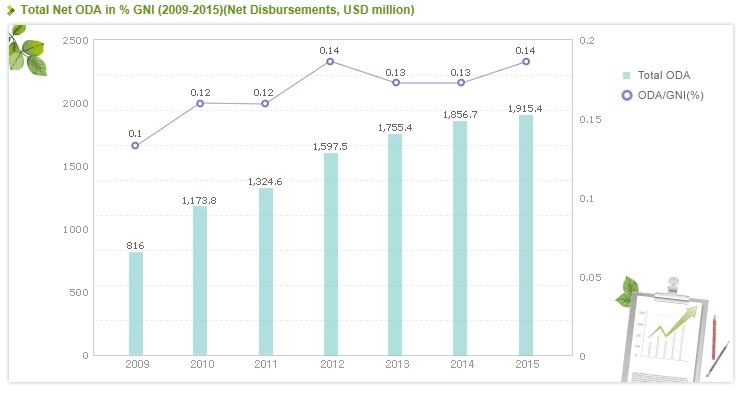
The Strategic Plan also projects a steady increase of the ODA/GNI ratio up to 0.20% by 2020, by which Korea can come close (0.14%) to the average level of DAC members and will continue to expand to meet the ratio. Of note, Korea’s ODA volume has increased in 5 consecutive years from USD 1,174 million in 2010 to USD 1,915 million in 2015, accomplishing the Korean government’s commitment to the international community in the midst of the global economic crisis. Within bilateral ODA, grants accounted for approximately 60-70% of Korea's bilateral ODA with slight variations in the past ten years.
- Korea's ODA by Type of Aid (2010-2015) (Net Disbursements, USD million, %)
|
|
2010 |
2011 |
2012 |
2013 |
2014 |
2015 |
|---|---|---|---|---|---|---|
|
Bilateral ODA (A) |
900.63 |
989.57 |
1,183.17 |
1,309.58 |
1,395.77 |
1,468.79 |
|
Budget support |
0 |
0 |
29.49 |
19.62 |
0 |
9.89 |
|
Bilateral core support & pooled programmes & funds |
28.69 |
42.26 |
95.95 |
140.67 |
143.01 |
138.41 |
|
Project-type intervention |
666.66 |
679.81 |
762.28 |
819.58 |
883.42 |
953.53 |
|
Expert and other technical assistance |
127.95 |
151 |
167.04 |
196.11 |
227.46 |
211.62 |
|
Scholarships and student costs in donor countries |
31.63 |
42.2 |
54.31 |
61.29 |
66.69 |
69.91 |
|
Debt relief |
2.36 |
0 |
0 |
0 |
0 |
0 |
|
Administrative costs and included elsewhere |
38.39 |
53.6 |
59.4 |
57.52 |
56.65 |
65.37 |
|
Other in-door expenditure |
4.95 |
20.69 |
14.71 |
14.78 |
18.55 |
20.07 |
|
Others* |
0 |
0 |
0 |
0 |
0 |
0 |
|
Multilateral ODA (B) |
273.15 |
335.02 |
414.28 |
445.8 |
460.96 |
446.6 |
|
To UN Agencies |
77.41 |
81.98 |
114.46 |
113.53 |
112.36 |
98 |
|
To AMCs, IBRD, IFC, MIGA, IDA, GEF |
112.53 |
125.24 |
154 |
170.57 |
193.53 |
198.01 |
|
To Regional Development Banks |
66.51 |
104.12 |
126.23 |
126.69 |
123.77 |
110.37 |
|
To Other Agencies |
16.7 |
23.67 |
19.58 |
35.01 |
31.3 |
40.22 |
|
Total ODA (A+B) |
1,173.8 |
1,324.6 |
1,597.5 |
1,755.4 |
1,856.7 |
1,915.4 |
* Others: ODA not assigned to the above categories (historical series)
** Source: OECD, International Development Statistics Online DB
- Korea’s Total Net ODA in % GNI (2009-2015) (Net Disbursements, USD million, %)
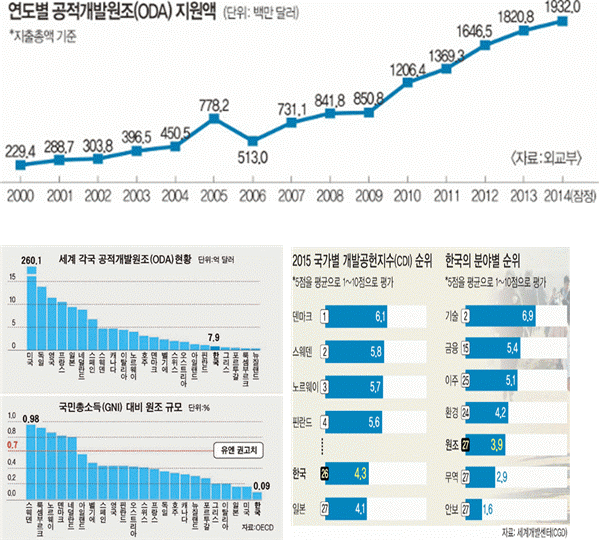
- Korea’s ODA Fund Rankings
YONSEI’S ODA PROJECTS (2011-2016)
- Over 31 projects with budget of KRW 21.9 billion
- List of Recent Major Projects
|
No |
Country |
Partner |
Project |
College |
Term |
|---|---|---|---|---|---|
|
1 |
Bangladesh |
KOICA* |
[Project Management and Consulting] Project for Establishing Graduate Nursing University in Bangladesh |
College of Nursing |
2013-2018 |
|
2 |
Ethiopia |
KOICA |
Project to Promote Family Planning and Maternal and Child Health in Arsi Zone |
College of Nursing |
2008-2011 |
|
3 |
Ghana |
KOICA |
[Project Management and Consulting] Project for Improving Maternal and Child Healthcare in the Volta Region |
College of Medicine |
2013-2016 |
|
4 |
Ghana |
KOICA |
Project for Improving Maternal and Child Healthcare |
College of Medicine |
2013 |
|
5 |
Malawi |
KOICA |
Project for the Prevention of Blindness in Malawi |
College of Medicine |
2014-2014 |
|
6 |
Mongolia |
KOICA |
Project for Managing Healthcare Supplies and Equipment for Healthcare Officials |
College of Medicine |
2013 |
|
7 |
Morocco-Fiji |
KOICA |
Cooperate in Managing Outcome of Tuberculosis Project |
College of Medicine |
2015-2016 |
|
8 |
Myannmar, Uzebekistan |
KOFIH** |
Dr. Lee Jong Wook Memorial Project Fellowship Clinical Program |
College of Dentistry |
2015-2016 |
|
9 |
Peru |
KOICA |
[Project Management and Consulting] Project for Capacity Building of Healthcare in Chanchamayo |
Graduate School of Public Health |
2013-2017 |
|
10 |
Philippines |
KOICA |
Follow-up Management of the Project for Capacity Building for Laboratory Diagnosis and Control Program of Tuberulosis |
College of Medicine |
2012-2014 |
|
11 |
Philippines |
KOFIH |
Project for Capacity Building of Tuberculosis Control in the Philippines |
Graduate School of Public Health |
2014 |
|
12 |
Tanzania |
KOFIH |
Dr. Lee Jong Wook Memorial Project Fellowship Program |
College of Medicine |
2013-2015 |
|
13 |
Tanzania |
KOFIH |
Project for Consulting and Strategy-building of Hospital Operation |
Graduate School of Public Health |
2015-2016 |
|
14 |
Uzbekistan |
KOICA |
[Project Management and Consulting] Program for Capacity Building of Infectious Diseases Control in Uzbekistan |
College of Medicine |
2014 |
|
15 |
Uzbekistan, Ethiopia |
KOFIH |
(Uzebekistan) Cooperation for International Development of Special Areas (Ethiopia) Project for Establishing Hereditary Heart Surgery Hospital |
College of Medicine |
2015 |
|
16 |
Vietnam |
KOICA |
[Project Consulting] Q-health Project in Vietnam |
College of Medicine |
2015-2018 |
|
17 |
Vietnam |
KOICA |
Haeng Bok (Happiness) Program (part of ROK's New Villages Movement: 새마을운동) in Quang Ti |
College of Nursing |
2014-2018 |
|
18 |
Vietnam |
KOICA |
Project for Follow-up Management of Binh Dinh Community Hospital |
Graduate School of Public Health |
2012-2014 |
|
19 |
Africa |
KOICA |
Nurse Training Program |
College of Nursing |
2013-2014 |
|
20 |
- |
KOFIH |
Project Evaluation and Establishment of Mid- and Long-term Operation Plans for Nursing Homes for Ethnic Korean Seniors Living Alone |
College of Nursing |
2014 |
|
21 |
- |
KOFIH |
Evaluation and Development of Training Program for Overseas Emergency Relief Healthcare Workers |
College of Dentistry |
2014 |
|
22 |
- |
KOICA |
[Joint Evaluation for WHO Health Project] Follow-up Evaluation for the Project for Preventing Mosquito-borne Diseases According to Climate Change |
Graduate School of Public Health |
2013 |
|
23 |
- |
KUCSS**** |
2015 Summer University Overseas Volunteer Program |
College of Nursing |
2015 |
*KOICA: Korea International Cooperation Agency
**KOFIH: Korea Foundation for International Healthcare
***KUCUSS: Korea University Council for Social Service
